17 October 2012

Velut arbor, ita ramus


I take my daughters to a skating rink twice a week. I should sit in the stands and watch them skate, but often pack a laptop, order a coffee, and settle down to work at a table in the cafeteria overlooking the ice. The place fills up with skaters waiting for their lessons to begin and families waiting for lessons to end. Skating lessons aren’t cheap: many of the regulars among the children come in private school uniforms: their parents look prosperous, some of them tony. It’s an upper-middle class preserve.

Siblings run pretty wild while their brother or sister skates. One boy who may have been seven or eight lobbed a soccer ball at the wall (he never failed to catch it) a few feet away from the mounted flat-screen TV, until, to be fair, his mother stopped him. The wonder, to me, was that he tried it at all. I’ve seen high-speed games of tag between the counter and the table, slowing only when one child hid under an unoccupied table. One day I had a visitor under my table, by my feet, for five minutes or so before his older sister coaxed him out. He might have been five or six, his sister ten, his mother—three or four tables down from mine—was chatting amiably with a gaggle of mums, all of them coping easily with a child or two. As behaviour, my squatter’s taking refuge beside my boots struck me as unusual, but not extreme: not what tends to happen, but what might happen.

A few days later the lure of after-Christmas specials drew me to one of Barcelona’s pricier grocery stores. From an aisle full of jars (mustards, sauces) I went around the corner into one stocked with olive oil and vinegar, some in plastic bottles, some in tin, some in glass, and dodged a ten-year-old on a scooter. He and his sister (also on a scooter) belonged to a tall, late thirties father in a navy jacket and quilted vest that might have been from Barbour’s. It was as though the bicycle-dodging pleasures of central Barcelona sidewalks had been re-scaled and reconfigured to make a scholar’s point about analogous public spaces.

All of this leads me to wonder whether a Catalan childhood leaves one ill-equipped to cope with the social world of a Catalan adult. If childhood can seem understructured, unbound, and untroubled by rules and authority, life at twenty-five, thirty-five, or forty-five often seems to comprise a series of administrative hoops through which the individual must leap, of increasing difficulty, in a kind of circus act where the citizen plays the elephant and the state, the tamer. Starting a business or applying to be vetted for tenure can entail trunkloads of paperwork and require consummate patience. I doubt that the cultures of childhood and adulthood make for a perfect match, and an easy transition, anywhere in the world, but I wonder whether they are here peculiarly ill-matched, and the transition distinctly difficult.

13 October 2012

How to Win the Catalan Election

I am willing to vote for Catalan independence. "Willing" does not mean "will": I have conditions. If these conditions are met, those parties which have invested themselves in the case for sovereignty may win a clear majority. My conditions are these:
  1. I ask to be told what's in the package: I need a list of ingredients on the box. Pro-independence sentiment stems from something that Catalans have in common with other Spaniards: deep dissatisfaction with the political institutions and political conduct arising from Spain's transition to democracy in the late 1970s. If independence means a calque of those same institutions and conduct--e.g. an electoral system that fosters cronyism and distance between the electorate and the elected, politics as a closed shop, and the absence of freedom-of-information legislation--Catalans will have sentenced themselves to another crisis of faith, with no-one to blame but themselves, just down the road. My first condition, then, is that independence have political content above and beyond sovereignty. That means public consultations and referenda on new political arrangements--levels of government, electoral processes, the regulation and funding of political parties, arms-length regulation of such matters are broadcasting, and guarantees of openness in public administration. That means that the range of possible arrangements should be part of the debate on sovereignty. 
  2. I ask for symbolic presence in the political process. Nearly 16% of the population is foreign. Many others are the children of newcomers, or newcomers themselves who have become citizens of Spain. A still greater part of the population is made up of migrants from elsewhere in Spain and their descendents. When a historically significant political party runs a slate of candidates whose surnames are almost exclusively Catalan, its aspiration to represent the whole of this society is compromised. (Perhaps it holds no such aspiration and is restrictively ethnolinguistic in scope, as Jacques Parizeau implied his own party was at the time of the 1995 Québec referendum.) Ideally  the election would see a far more representative group of Catalans take up their seats in the legislature. If that is not the case--and the electoral system makes it very unlikely--the parties advocating sovereignty should enlist independents from civil society groups representing both waves of immigrants, those of the 1950s and 1960s, and those of the first decade of this century. 


17 September 2011

The Queen's Smile


Few will recognise anyone but Elizabeth II in this photograph. It was taken in Canada in 1982. In the photograph, the queen is signing the Canada Act, Canada's patriated constitution, unencumbered by the Westminster Parliament. (Until the 1980s the constitution of Canada was an act of a foreign sovereign parliament. Patriation meant removing the power of that parliament to change Canada's basic law. Australia and New Zealand also patriated their constitutions, shortly after Canada did.)

As there was no amending formula, the Supreme Court of Canada was asked to clarify what could--legally--and should--conventionally--be done to introduce a mechanism for amendment in the future. The judges accorded Canada's federal parliament the power to unilaterally patriate the constitution, without resort to a referendum or a process of ratification by Canada's provinces. Yet they also stated that according to convention, the federal government should consult, and seek to secure the consent of, the provinces before proceeding. The judges distinguished what was strictly and narrowly legal from what was politic and in accord with unwritten principles of Canada's constitutional arrangements. Consent to patriation, to the amending formula, and to a charter or rights and freedoms was secured from nine provinces, but not from Québec. The Government of Québec is circumscribed by Canada's constitution without having assented to it, as it stands today. Thus, it seems, the queen's awkward smile:


What was done could be done, but should it have been done? What could be done was two parliamentary votes, one in each house of the Canadian parliament. That sufficed to change the constitution. But the legally sufficient was not the wisest course of action. The greater the consensus, the stronger the constitution as basic law: and constitutional arrangements made without Québec might as well have been made against Québec.

All of this, by way of a parallel: the new text of Article 135 of the Spanish Constitution, an amendment limiting the power of the state or of any subsidiary public administrations to take on debt, has been approved by parliamentary vote in the two chambers of Spain's parliament and signed into law by the king. Over 90% of members of each chamber approved the amendment, obviating the need for a referendum: the amendment will become part of basic law without any process of ratification. In only one of the chambers are seats distributed as a direct function of a public electorial process (some Spanish senators are appointed rather than elected). Neither party voting to pass the amendment made any mention of it in the 2008 general election campaign; nor did the two parties together command a qualified majority of support of the Spanish electorate. (Turnout was 73% in 2008: the PSOE's support, in terms of the number of potential voters, was 32.4%, and the PP's 29.5%.) In good conscience, some of Mr Zapatero's or Mr Rajoy's deputies should have abstained and forced a referendum. That they did not should give the king of Spain the same awkward smile of discomfort when he signs the amendment into law.


04 July 2011

Professor Pajín?

Former Senator Pajín,* current Minister of Health and Social Services, formerly a junior minister for international development, is thirty-five years old. She was twenty-four when elected to Spain's lower house in 2000. As neither the her own ministry nor her own party (in which she is responsible for a key secretariat) furnishes much in the way of biographical data for the senator, it's difficult to know what she was up to before the 2000 election. In 1997 she was the head of the youth wing of the Valencian Socialist Party and by October of that year was a student representative in the senate (claustre, in Catalan) of the Universitat d'Alacant. Did she go on to teach at her home university? The questions comes up because of the statement, in a blurb appended to an article by Pajín in the United Nations Chronicle, that she was a "member of the faculty" in Economics and Sociology at the U of A. The blurb, like the article, is only available in English. It dates from a time when Senator Pajín was Secretary of State for International Cooperation. "A member of the faculty" means, in the strictest sense, someone who has taught at university, charged with responsibility for a course rather than merely, say, correcting exams. Was Senator Pajín ever Prof. Pajín? If so, why is this information only available in English, in a  journal published in New York? If not, who said she had been, and why?

* Pajín gave up her seat in the Senate on 29 June 2011.

19 June 2011

Newcomers, Parties, and Bad Faith

A recent post took up the representation of newcomers under Spain's electoral system, which circumscribes d'Hondt method proportional representation to Spanish provinces for general elections and those held in autonomous communities, thus dividing the polity--however imperfectly--into smaller units. The same system obtains in local elections, without the subdivision of the territory voting on its governance. I argued that this system will ensure the under-representation of immigrants are party slates are drawn up with an eye to go unnoticed, save the first two or three spots. Catalan demographics are such that a viable immigrant candidacy might--and this has not been tested--do a slate more electoral damage than good. As immigrant-dominated neighbourhoods have no voice per se, everything about them--income, language, religion, newness of population, education--is swallowed up by the municipality as a whole. It's low-resolution local politics: constituencies are ostensibly ideological, though in practice they are social networks bestowing favours to   bind voters to their brands.

In this post, I'd like to argue that the PSC has acted in bad faith in soliciting the votes of newcomers. At issue is the following poster, which I noticed the other day at a call centre on Ronda de Sant Antoni:


Columbian-born Erika Torregrossa was thirtieth on a list of forty-one candidates. For her to have been elected, the PSC would have had to garner something approaching 75% of the vote, yet no party has ever won more than 45.2% of the vote and no party is ever likely to take 75% in a party system as fragmented as that obtaining here (or, indeed, in any democratic polity). The slogan is disingenuous. Ms Torregrossa was run in the equivalent--in a first past the post system--of an opposing party's safe seat. A vote for Mr Hereu was not a vote for a Latin American city councillor. Had Ms Torregrossa been given the fifth or tenth slot on the slate, it would have been: but Mr Hereu drew up the slate, and Mr Hereu consigned Ms Torregrossa to losing. By paying mere lip-service to pluralism and the political representation of newcomers, did Mr Hereu act cynically? Has he bettered or worsened the lot of immigrants as politically active citizens? Is he better or worse, in this respect, than the new mayor of Badalona, Mr. Xavier Garcia Albiol. Mr Hereu would say that he meant well: but did he act well?

My second objection is to the exclusive use of Spanish on the poster. A Catalan text may or may not have been understood by the constituency the PSC wanted to win over (such things depend on lexical choices). A bilingual poster would have better express the party's policy that Catalan should be the shared medium of civic life in Catalonia. Excluding it from the poster contradicts that policy.

My third objection arises from a coincidence: both El Mundo and El Economista  refer to Ms Torregrossa as one three candidates who constitute "la representación de las personas inmigradas". The stories were syndicated by different press agencies; overlapping phrases (of which there are many) point to copy from a party press release.  Yet the last of Mr. Hereu's candidates was another immigrant, the Sussex-born architect David Mackay. If the party's press release did refer to immigrants on the party's slate and disassociated one immigrant from the rest, double standards are in operation. The PSC is not alone in this respect.  But more about the peculiar status of some immigrants in Catalan society in another post.

28 May 2011

Demographic and Democratic Change

Earlier this month forty-one candidates were elected to Barcelona City Council. All were born in Spain. Forty were born in Catalonia. Thirty-five were born in the city itself. That is, forty out of forty-one hail from the city or its hinterland: one is from further afield, a Spanish-speaking town just under three hundred kilometres away, though she moved to the city when she was six.

How well do these forty-one elected officials reflect the city as a human community? Are our representatives representative? How much do they have in common with the city they govern? Age, sex, ethnicity, and origin are givens: we cannot change when we were born, or where, or whose children we are, or the culture in which we were raised. If people with whom we share any of these traits seem to be left out of the political process, we may perceive the slight as exclusion, though ostensibly the product of a free and open process. Electoral quotas have accordingly addressed the under-representation of women in the democratic institutions of dozens of countries (for which, see http://www.quotaproject.org/index.cfm). Whether or not one agrees with obligatory quotas as a measure, the principle that representative democracy loses its legitimacy as citizens lose their faith, or belief, in the process is not abstract: it is socially palpable, camped out in city squares all over Spain. Rather than addressing those outraged by politics in 2011, I want to consider who might feel excluded, and outraged, in 2021, or 2031.

As of January 2011 278,320 city residents did not hold Spanish nationality. They account for just over 17% of the population. Not all newcomers are non-nationals, as longer-term foreign residents--the present writer among them--become citizens of Spain and those drop off that particular statistical map. About 22% of the city's population was not born in Spain, of whom a few were born to a Spanish parent or Spanish parents residing abroad. Let's say, then, that 20% of the city's population is made up of newcomers, and a growing but as of yet unknown percentage of the children of those newcomers, some of whom will have acquired Spanish citizenship at birth (if one of their parents had become a citizen beforehand), and some of whom are born foreign. As of 2009, about 20% of those born in the city were not citizens; another 14% was the child of one Spanish and one non-Spanish parent.

Rounding up to include immigrants who are now citizens, the city's first and second generation immigrant population is likely around a quarter of the total. Another 7% was born elsewhere in Catalonia and 20% in the rest of Spain. Among the 51% born in the city, there must now be a considerable number born to immigrant parents. Yet 85% of city councillors are native to the city, and 97.5% native-born Catalans. Newcomers are not represented; and as they are not, one fifth of the city is not. (There are a handful of newcomers among the city's 170+ unelected district councillors, as a handful appeared on the lists of one of the main party's in this month's election--far enough down the list to make their candidacy political fiction.)

The phenomenon is recent. The boom in immigrant numbers came between 2001 and 2006. Two political responses to this tectonic shift in Catalan demographics are available to influence public opinion. One consists quite literally of cooking shows on Catalan television: Karakia on TV3, Els nous catalans on TVE's Catalan service. (The Spanish-language service broadcasts Babel, similar in content and format.) The gesture may be welcoming and the stance dialogic, but one fact narrates another, the old population gracefully talks about the new. At the other extreme, Josep Anglada and his fellow travellers are openly racist, xenophobic, and popular enough to garner 67,000 votes. Do cooking shows counter Anglada? Well-intentioned multi-culturalism can never substitute for the beginnings of demographic parity in democratic institutions. If Mr Anglada is to be matched point for point, the best person to do so is one of the very newcomers he loathes.

21 May 2011

A Comparative Study of the Expense of Spin

An apolitical reflection, as today is apolitical by statute. The following OECD municipalities are rough equivalents of Barcelona (1.62 million) in terms of population:

Hamburg: 1.8 million
Philadelphia: 1.55 million
Montreal: 1.62 million
Vienna: 1.7 million
Budapest: 1.7 million

Four of the five examples are in distinctly richer countries. Logically, Barcelona's spending on communication--much of it spin, advertising, posters, freesheets: propaganda--should be equivalent to or lower than its analogues.

How much does Barcelona spend on communication? The relevant items from the 2011 budget read as follows,


To items 92502 and 92503 one must add a further expenditure classified as an unclassifiable expense, i.e.


The sum total of 92502, 92503 and 22602 is 31,729,211 euros, equivalent to the starting salary of 1322 nursery school teachers working for the City. 

How does this compare with the OECD city whose population comes closest to matching Barcelona's? Here are the figures for Montreal:


In euros, that's 3,128,812--less than 10% of the figure for Barcelona. Last time I was there, the snow ploughs made their rounds, the sidewalks were clear, the buses running, the bagels delicious (in both languages). Montreal is a mature democratic polity. What is Barcelona?


21 March 2011

Conflict of Interest

In an earlier post I noted that a former Vanguardia columnist, Eugeni Madueño, was behind a newly launched publishing venture, Edicions Clariana.  Clariana and by extension Madueño have produced more than one hundred pages of City of Barcelona colour inserts in La Vanguardia since early January. Yesterday's paper brought two such inserts: one published by Clariana, and one--the one-hundred page glossy Vivir en Vanguardia--by La Vanguardia itself. The latter looks like a magazine, yet there's nothing on the spine, and an ISBN rather than an ISSN; of only four pages of add copy, two were placed by the city hall. One of these two pages, the back cover, is simply the City of Barcelona logo magnified to 75% of the width of the page. That is, it nearly looks like an official publication. The editor? Eugeni Madueño. Madueño is both publishing for city hall and working for a paper with a mandate to cover city hall. Mr. Madueño would seem to be subject to a conflict of interest: he can't be expected to report objectively on a level of government which is paying him. Then again, it may be naive of me to expect a clean separation of the fourth estate from government.

13 March 2011

Colours

Once upon a time, Barcelona Council advertised its presence thus:


That is, white lettering on turquoise stood for the municipal corportation. By 2006, at least one campaign had abandoned turquoise for red:

Since late 2010, many public building administered by Barcelona council have be rebranded to make the link more conspicuous:


One notices that white lettering on a red background carries the most important message content, and that every plaque carries with it an implicit good vibe (the letter 'B' and the Catalan for 'well' or 'good' are homophones). To what might we owe this new colour scheme? Just a suggestion:

What's Wrong with Catalan Schools? (III)

In the 2009 OECD Pisa Report, my home school system of Ontario scored 531 points for reading skills, with a fairly narrow spread between the lowest and the highest scores. Spain and Catalonia rated lower, as they did in mathematics, despite steady improvement across the 2003, 2006, and 2009 reports. (Scores for reading stood at  481 and 498, respectively.) Ontario schoolchildren spend sixteen more days at school per year than do their Catalan counterparts, which may go some way to explaining the difference in scores. My first question, then, is why there is no public debate in Catalan media about the number of contact hours as an aspect of education policy.

More worrying than overall scores is the shape of bell curve for Spanish reading scores. Consider this:


Click for a larger image.

Source: http://www.statcan.gc.ca/pub/81-590-x/2010001/tbl/tblb1.13-eng.htm

Reading scores are here broken down into six ranges. How many students score in the highest of these six ranges? In Ontario, it's 1.9%; in Spain, it's 0.2%. How many score in the two two ranges, Levels 5 and 6 together. In Ontario, it's 14.2%; in Spain, 3.4&. How many score in the top three ranges, Levels 4-6? In Ontario, it's 41.9%, in Spain, 21.2%. Spain catches up with the rest of the developed world with very healthy percentages in Levels 2 and 3--both of are tantamount to a passing mark--but does very poorly if one concentrates on students who are scoring particularly high. Numerically, Spain does a poor job at producing brilliant students. Thus my second question: Why?

20 February 2011

Report Card: The Foundation for Science, Health and Education

Too tired to talk politics, I've decided to prolong January's exam marking drudgery by applying to the English versions of Catalan web sites, in the public or the third sector, the same standards applied to English majors at Catalan universities. In all cases, I want to ask if money has been spent well--and in some cases, if I conclude that no money has been spent, money not spent is not money well spent.

Valentí Fuster runs the Zena and Michael A. Wiener Cardiovascular Institute at Mount Sinai Medical Center in Manhattan.  He's a highly distinguished man of whose accomplishments a proper account would fill the front matter of heavy book. He is also publicly minded. Early in 2010 he leant his name to a third-sector initiative, the Science, Health and Education Foundation, headquartered in Barcelona, whose mandate it is to raise awareness of cardio-vascular health among school-age children.  The foundation's website--http://www.fundacionshe.org--is available in English, Catalan, and Spanish.

The English text is not always comprehensible: "Make enjoy to your ear while helps the foundation" reads a prominent sidebar on the welcome page. Some translations are not complete, with Spanish text left dangling at the end of the English version. The translator is not a native speaker and in all likelihood does not have a university training in translation, for there is no evident regard for register or pragmatics. The literalism of rendering "Contact con nosotros" as "Contact with us" (a mistake Google Translate does not make) makes one think that the translator lacked university training in modern languages; and there has been  That said, the message content is decipherable to those with a great measure of patience.

Mark: 3/10.

03 February 2011

Good News

The Generalitat is to drop €3 million from its budget by scrapping a quarterly glossy, InfoCatalunya, delivered to every Catalan home. Without so much as a hiccough, La Vanguardia describes InfoCatalunya as featuring "propaganda de la obra del Govern". It will not be missed.

23 January 2011

Branded

In an earlier post, I noticed that the PSC is hooked, as an addict would be hooked--painfully and destructively--on public sector advertising serving party political ends. The PSC has lost the Generalitat, and looks set to lose control of both Barcelona City Council and the Barcelona provincial Diputació. With every euro of public money the PSC spends on selling its own virtues, the hole it is digging for itself gets a little deeper.

Bundled together with today's Vanguardia, cheek by jowl with a flyer from PC City, is a 36-page magazine published by City Hall. The writers are La Vanguardia staffers; the production credits go to Edicions Clariana, for which the single Google hit is the company's own static web page. (Garnering one and only one hit from Google in 2011 is an achievement worthy of a Twilight Zone remake or a Jason Bourne thriller.) The title, Barcelona: Presupuesto 2011, belies the dirth of hard numbers between the covers. This magazine, or flyer, or pamphlet, was not intended for accountants. In 36 pages, it manages 36 colour photographs (though one page is mysteriously blank, evidence of self-censorship or a rush). There is no pretence of objectivity. Every headline casts the government of the city in a favourable light; every photographs tells an upbeat story. Hyperbole abounds: "Limpieza contante" reads one headline, as though we'd woken up in a city where street cleaners never slept. Two politicians make glossy, well-lighted appearances: Mayor Hereu and Deputy Mayor Jordi Carnes, both PSC men. Mr. Hereu's coalition partners do not.

The joke, of course, is on Mr. Hereu. He's spent money to sell the message that he's not wasting money, but to do so is to waste money and insult the democratic instincts of an electorate which, if it fails to vote, does so out of a mix of disgust and decency. Mr. Hereu had branded himself, in both senses of the word.

To top it all, it's all in Spanish. There's not a word of Catalan.

28 September 2010

What's Wrong with Catalan Schools? (II)

The Catalan school system has three tiers: state/public schools compete directly with publicly funded independent schools, which compete in their turn, more obliquely, with entirely private schools. The independent schools are not authorised to charge tuition, but do.

Three tiers means that greater public funding goes to public schools, from which the greatest uniformity is expected (though some experimentation is allowed). Independent schools are in less of a straight-jacket--for example,  single sex schools receive public funding--but share few resources and they do not work as a network. Special programmes are specific to one school, and few schools can have the numbers to set up enriched math, English, or French classes. Consequently, grouping by ability is, like specialisation, almost impossible, and it is left to private schools--and, socially, to the rich--the pursue enriched curricula from which many more students could benefit.

12 September 2010

What's Wrong with Catalan Schools? (I)

Stuyvesant High School, founded in lower Manhattan in 1904, has graduated four future Nobel laureates, as well as the Attorney General of the United States. The Bronx High School of Science (1938) boasts seven Nobel-winning alumni, and the Brooklyn Technical High School (1922) two. All three schools are public. None charges tuition. All are selective, basing admission on an entrance examination. All thirteen Nobel prizes were in science or economics. In the same period, seven Nobel prizes have been awarded to Spaniards, five of them to writers. In science, then, three New York City public high schools with a student population of under 11,000 have out-produced a country of over forty million by a factor of six.

There is limited specialisation in Catalan secondary schools, available to students aged 16-18. It is not selective. There are no entrance examinations. Admission to programmes emphasising music and drama entail can be based on auditions, but is otherwise based on across-the-board academic standards. It is not a student applies for admission to university, and thus to a specific major or concentration, that the link between academic merit and the right to walk through a specific set of doors every weekday morning appears.

In publicly funded education, then, students are grouped by area of residence (which often means socio-economic grouping) and in accordance with their parents' religious, linguistics, and ideological preferences. The gifted are not segregated for so much as half a day per week, though legislation requires that they receive special attention, and academic achievement is not rewarded by more challenging work and brighter, more dedicated schoolmates. Elitism is left to the private sector. It shouldn't be.

08 September 2010

What's Wrong With This Picture?

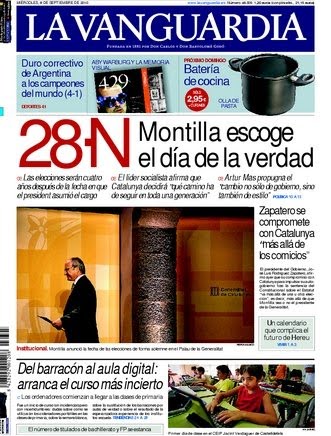
Yesterday Mr Montilla called an election. Today's Vanguardia leads with the election call:


Yet at the end of the op-ed pages, a full colour-illustrated spread sells the speed, safety and toll-free status of the Catalan highway system:


And:


So what's wrong with this picture? On the very day of an election call, with the prospect of voting near, tax money has been spent to tell voters that those governing are good governors and deserve to go on governing, which entails voting for them.  There is no cynical asperity, I hope, in pointing out the cynicism of the manoeuvre, the ill service that it does to democracy, the waste, and the imbecile rapacity of the political calculus which it presupposes.

07 September 2010

Bell, California

Might Barcelona be better served by its newspapers than Los Angeles, whose metropolitan area more than doubles that of Barcelona in population? Los Angeles has one metropolitan daily; Barcelona has four. The L.A. Times daily circulation comes to over 600,000, relative to a local population (that of L.A. County) of nearly 10 million. The four Barcelona dailies--La Vanguardia (235,000), El Periódico (180,000), Avui (37,000), and El Punt (30,000)--give Barcelona three quarters the number of daily newspapers in circulation as Los Angeles in absolute terms, relative to a local population of 5.5 million in the province of Barcelona. To the figure for the L.A. Times one would have to add both the L.A. circulation of USA Today and dailies that target smaller markets within the country, such as the L.A. Daily News and La Opinión. Similarly, for Barcelona one would have too add the circulation of a half dozen Madrid dailies which publish Barcelona sections or supplements in their local editions.

This issue suggested itself when, in L.A. County, the Times blew the whistle on city officials in Bell, a municipality of about 36,000 to the south and east of downtown.  Like Lester Freamon of The Wire, two Times journalists followed a paper trail: what they found was a +$1.5-million salary, a string of +$400,000 salaries, and a political clique that had been lining its collective pocket as best it could for six years. Obfuscation and loopholes had kept citizens in the dark. A print medium did its job, found the dirt, ran the exposé, and heads--a lot of heads--began to roll. The city is now run by an interim administration.

Perhaps a dozen place names in L.A. County are familiar to movie-goers all over the world. Bell is not among them. Bell is poor, largely Hispanic, and prone to lower voter turnouts: 400 people voted in a plebiscite which gave the now disgraced officials the loophole they needed to circumvent state law and get rich quick. Now that transparency and accountability have returned to Bell, they key question is why they were absent for so long.

The classic source of scrutiny in a liberal democracy is the press. In Bell, it took the press six years to expose the rot. Would it have taken as long in a two-, three- or four-newspaper town? A paper like the L.A. Times is far less reliant on public-sector advertising than one like La Vanguardia, but does that matter if the ratio of print media resources to population shrinks to such an extent that beats are not covered? There's a reason why the final season of The Wire was set in the Baltimore Sun newsroom: newspapers are to democracy what canaries are in a mine. If they die off, the oxygen is going. Even if Spanish papers sometimes read like mouthpieces for political parties of factions thereof, at least they compete, and their investigative resources, if trained on the idealogical enemy, are at least engaged and productive. If public money keeps more papers going, could it be a good thing? Is subsidised Barcelona better off than L.A.?

23 August 2010

Politics and Translation

Nothing so frays the tweed, so to speak, of my political convictions as the gratuitous or foolish spending of public funds. Waste feeds the rhetoric of those opposed to the state's corrective role in a free society, as a supplement to the market. For a generation, the epithet "tax and spend" has been used as though it meant tax and waste. Waste taints any policy, however commendable.

Public commemoration of the second Spanish republic, the 1931-1939 Generalitat, the political opposition to Franco and the agents of change during the transition to democracy is such a policy: whether or not it's right for the Catalan authorities to pursue such an objective, or pursue it in the manner in which it is being pursued, there is waste in the programme's budget, though waste most Catalans will never notice.

The waste accompanies an exhibition of very large format photographs of public places, placed in the places they portray. The photographs were taken in Barcelona between 1936 and 1978; they record moments in the political life of the city. Each photographs is accompanied by eight texts: a general introduction to the exhibition (in Catalan, Spanish, English, and French) and a note on the photograph itself (in the same four languages). Here is the introduction, in Catalan:


And in English:


The translation is poor, but not awful. Now take a look at some of the notes appearing alongside the photographs themselves:


This is so badly garbled that the sense is lost.

Eleven of the twelve photographs have been placed where foreign visitors are most likely to see them: in three central squares, and on a main shopping street. To the visitor with a good command of English, the campaign--and with it, both Catalonia as a polity and as a society (a public campaign is not perceived as a one-off, like a restaurant menu)--conveys either a lack of English language skills, or a lack of concern with the quality of the translations. The translators, who should not be blamed for accepting work while the Spanish economy contracts, are young translation graduates, but not native speakers. The graphic designer, however, is from Liverpool. If he saw the translations, he might have corrected them, or alerted those who had commissioned them that the English texts were sub-standard. Executive responsibility for the exhibition lies with Ricard Martinez, a Barcelona alderman for ERC. If Mr Martinez curates any more exhibitions, he should either save the public money by not commissioning translations, or see to it that the quality of translations is taken as seriously as graphic design.